


Today’s newsletter is sponsored by Xplor Pay, a full-service payment provider. They make it simple for software companies to accept payments, enhance the customer experience, and boost revenue. Their flexible partnerships, including PayFac as a Service, are structured to help SaaS providers scale with confidence and streamline their payments operations.
Learn more at xplorpay.com
Alright, let’s get to it…
I used to pay for Grammarly. I had a Notion subscription. I was looking at writing assistants, transcription tools, project management platforms—the whole horizontal SaaS stack that we all thought would be around forever.
Now? I use an LLM for probably ~80% of what those tools did.
And I’m not alone.
Here’s what’s actually happening: LLM companies are eating horizontal SaaS alive. Not slowly. Not eventually. Right now. In 2026, we’re watching the great unbundling of horizontal software happen in real-time, and it’s one of the most important shifts I’ve seen in my 15+ years building software companies.
Let me break this down.

The Horizontal SaaS Extinction Event
Think about what you’re using AI for today compared to two years ago.
I bet you’re using ChatGPT, Claude, or Gemini for:
Writing and editing (goodbye Grammarly)
Note-taking and organizing thoughts (sorry Notion, you’re trying to fight back)
Research and summarization (RIP traditional research tools)
Basic data analysis (Excel formulas? ChatGPT writes them now)
Customer support responses (those SaaS help desk tools are sweating)
Meeting summaries and transcription (dozens of startups are in trouble)
The pattern is clear: any horizontal SaaS product that can be replicated by prompting an LLM is in serious danger.
I was talking to a founder friend last week who’d built a $4M ARR horizontal SaaS business over five years. Beautiful product. Great retention. Then ChatGPT dropped a feature update that did 70% of what his product did... for free. His churn went from 3% monthly to 12% in six months.
That’s not a competitive threat. That’s an extinction event.
Why LLMs Will Never (Really) Touch Vertical Markets
But here’s where it gets interesting for us in vSaaS land.
LLMs are absolutely dominating horizontal use cases, but they’re terrible at vertical markets. And they always will be.
Why?
1. Domain complexity is the moat
Building software for restaurants isn’t just about taking orders—it’s about kitchen workflows, inventory that spoils, labor scheduling around rush hours, supplier relationships, health code compliance, and a thousand other nuances that only someone who’s lived in that world truly understands.
Toast doesn’t just process payments. It understands that you need to 86 items in real-time across all order channels. That your line cooks need a different interface than your servers. That your labor model is fundamentally different on Tuesday lunch versus Saturday night.
Can ChatGPT help a restaurant owner? Sure, with generic advice. Can it run their restaurant? Absolutely not.
2. Integration is the real product
At CourseKey, we didn’t win because we had the best UI or the smartest algorithms. We won because we integrated with student information systems, payment processors, accreditation bodies, and state reporting requirements that were specific to career colleges.
That integration work—the boring, tedious, compliance-heavy stuff—is what created real value. LLMs can’t do that. They can generate code, sure. But they can’t navigate the political dynamics of getting IT departments at 50 different schools to grant you API access. They can’t understand why one state requires attendance reporting in a completely different format than another.
3. The trust factor
Would you let ChatGPT run payroll for your $10M business? Would you let it manage your medical practice’s patient records? Would you trust it to ensure your construction company is complying with OSHA regulations?
No. Because when things go wrong in vertical markets, the consequences are catastrophic. You don’t get fired, you get sued. Or people get hurt. Or your business shuts down.
Vertical SaaS isn’t just about features—it’s about being the trusted partner who shows up when the health inspector walks in unexpectedly.
The Broad Vertical Exception (And Why It Proves The Rule)
Now, you might say: “But Luke, OpenAI just launched ChatGPT Health! They’re going after healthcare!”
And you’d be right. Last week OpenAI announced ChatGPT Health, letting users connect medical records and wellness apps to get personalized health guidance.
But notice what they’re NOT doing: they’re not trying to run hospitals. They’re not building EHR systems. They’re not processing insurance claims or managing clinical workflows.
They’re going after the consumer health information layer—which is basically a horizontal play within an extremely broad vertical. It’s like how Google went into “healthcare” by letting you search for symptoms. That’s not vertical SaaS. That’s a horizontal tool applied to a vertical topic.
The real healthcare software—the stuff running hospitals, managing patient care, processing billions in insurance claims—is still dominated by vertical players like Epic, Cerner (Oracle Health), and Veeva. Why? Because that software requires:
Decade-long implementation cycles
Integration with hundreds of legacy systems
Regulatory compliance that changes constantly
Deep understanding of clinical workflows
Trust relationships built over years
No LLM company is going to replicate that. It’s not sexy. It’s not viral. It’s not a product you can launch with a blog post.
Why It’s Silly For Big LLM Companies To Focus On True Verticals
Here’s the other thing people aren’t talking about: there’s still no clear LLM winner.
OpenAI has ChatGPT. Anthropic has Claude. Google has Gemini. Meta has Llama. And every few months some new model drops that changes the rankings.
When you’re in an existential battle to become the foundational AI platform, you don’t have time to figure out the intricacies of HVAC dispatch routing or dental practice management software. You’re focused on making your model 2% faster, 5% cheaper, or 10% smarter on benchmarks.
Going deep into big verticals—like what it would take to actually compete with ServiceTitan or Toast or Procore—is a massive distraction when you’re still trying to win the foundation model war.
Will we eventually see an LLM company that has clearly won and THEN decides to go vertical? Maybe. And only if it’s such an extraordinary market opportunity. These companies have gotten so big that a billion dollar opportunity won’t even move the needle for them.
And by then, the vertical SaaS companies will have integrated AI so deeply into their products that the LLM company will be 5+ years behind on domain knowledge, integrations, and customer relationships.
The Math That Explains Everything
Let me put some numbers to this.
If you’re building horizontal SaaS today, you’re competing with:
Free AI tools that get smarter every month
Zero switching costs (users can just... stop using your product)
No network effects (AI gets better for everyone simultaneously)
Commoditized capabilities (whatever you build, an LLM can replicate in months)
Your LTV is going down. Your CAC is going up. Your retention is getting worse. You’re in quicksand.
But if you’re building vertical SaaS, you have:
10-20x longer sales cycles (which sucks for you but creates massive moats)
80-95% net revenue retention (customers can’t leave without blowing up their business)
Multiple revenue streams (SaaS + payments + fintech + data)
Compounding domain expertise (every customer makes you smarter about the vertical)
The market is telling us something.
What This Means For You
If you’re thinking about starting a software company in 2026, here’s my advice:
Don’t build horizontal SaaS. Just don’t. I don’t care how clever your idea is. Unless you have $100M in funding and a plan to get to $1B in revenue in 3 years, you’re building a melting ice cube.
Do build vertical SaaS. Find a specific industry that’s underserved by software. Get to know that industry deeply. Understand their workflows, their pain points, their regulatory environment, their economics. Build software that’s so tailored to their needs that using a generic AI tool would be like trying to do surgery with a butter knife.
The opportunity has never been clearer. Horizontal software is being commoditized by AI. Vertical software is becoming more valuable every day.
The death of horizontal SaaS is the golden age of vertical SaaS.
And we’re just getting started…
New / Free Resource :-)
I’ve got exciting news for you all…
I made all my content free and spent Winter Break building out VerticalSaaSGroup.com
It’s PACKED with hundreds of case studies, playbooks, market studies, industry analysis, deep dives, etc…
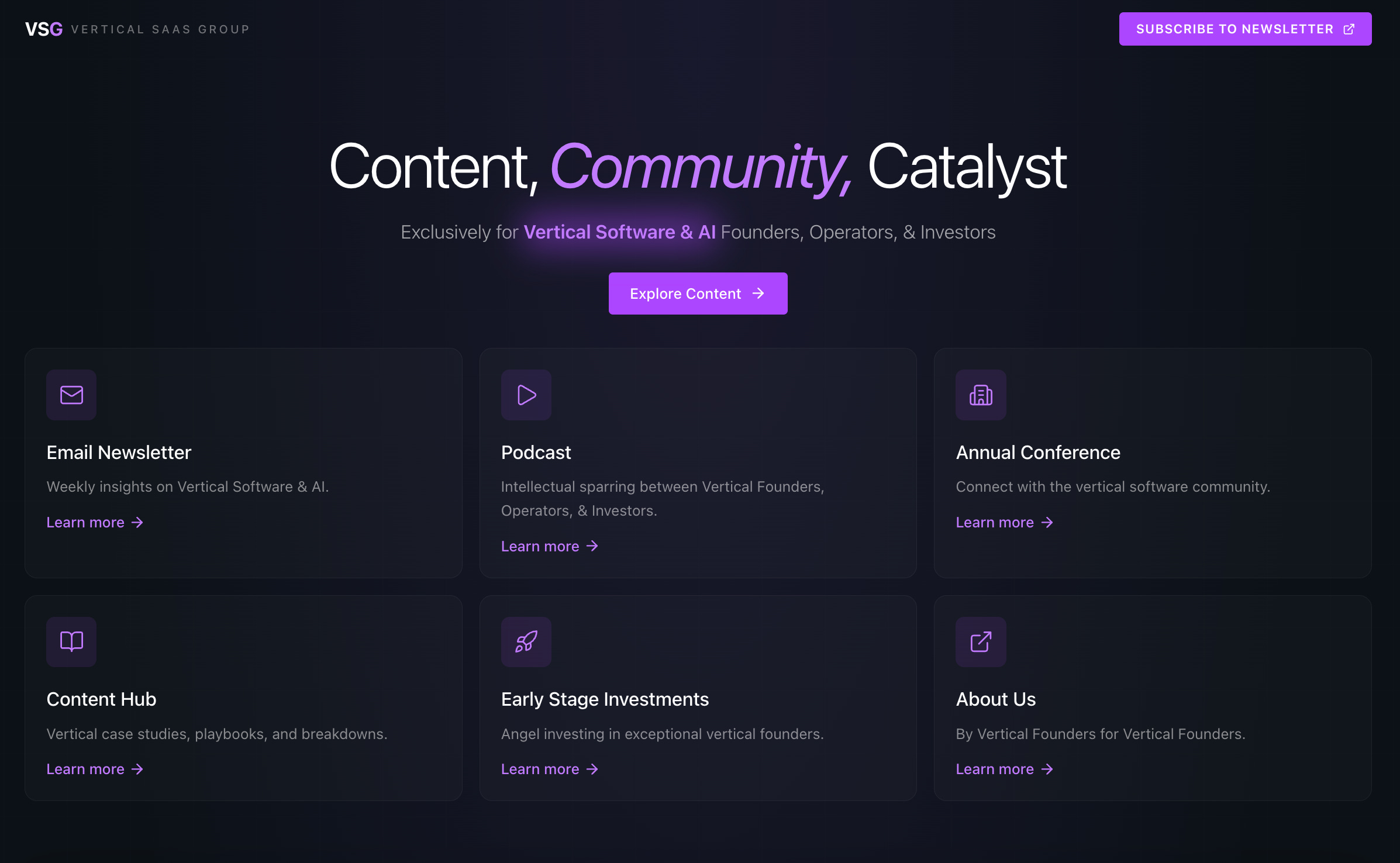
The Content Hub has 1,000+ pages of Case Studies, Playbooks, and Breakdowns:
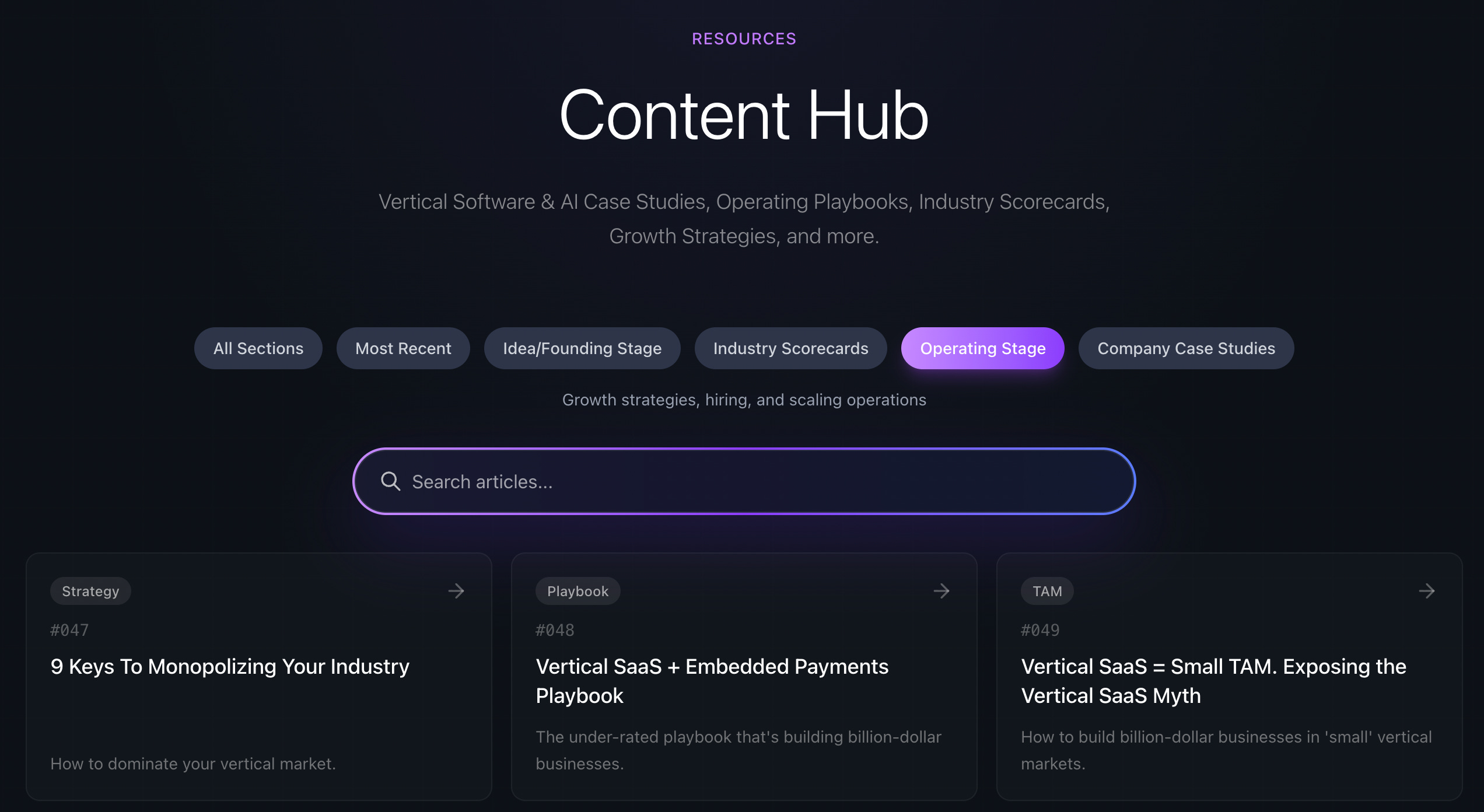
The Podcast section has 12+ videos (and a new one dropping every week) with leaders in Vertical Software & AI sharing their wisdom with us:

And we have a conference section if you’re interested in 2026’s Vertical Software Summit. I’m also going to drop all the sessions from 2025 here as well.

And much much more over at VerticalSaaSGroup.com for you.
I have so much fun doing this with ya’ll. Check it out and let me know what you think, if it’s helpful, and how we can continue to deliver value for you on your journey.

The Payments Sales Comp Structure That Actually Works
Alright, let’s talk about one of the problems in vertical SaaS: how the hell do you compensate sales people when their selling payments (not software)?
This isn’t like selling SaaS seats. You can’t just pay 8% of first-year ACV and call it a day. Payments revenue scales over time, utilization varies wildly, and if you get the comp structure wrong, you’ll either go broke paying commissions or your sales team will revolt.
I learned this the hard way at CourseKey. And last week I got to dive deep on this with Rahul Hampole, who’s run payments and fintech at Yelp, Plaid, and now ServiceTitan. The guy has seen every variation of this problem that exists.
So let me save you about $500K in mistakes and share what actually works.
The Problem With Standard SaaS Comp Models
Let’s start with why traditional SaaS sales comp breaks when you add payments.
In pure SaaS, the math is simple:
Sales rep closes $100K ACV deal
You pay them $10K commission (10% of first-year ACV)
Customer pays you $100K over 12 months
Everyone’s happy
But with payments, the revenue compounds over time based on customer usage:
Sales rep signs a customer they project will do $500K in payment volume
Customer actually does $50K in the first quarter (10% of projection)
Customer then does $200K in Q2, $300K in Q3, and $600K in Q4 (hit their stride)
Or... customer does $50K in Q1 and then churns
If you pay commission upfront based on projections, you’ll get burned. Sales reps will inflate GMV forecasts, you’ll pay out big commissions, and then the customer won’t use the product.
If you pay commission only after the customer hits utilization, sales reps won’t prioritize payments deals because the payout is too far in the future.
This is the Rubik’s cube of SaaS comp design.
My Favorite Model: Split Comp With Utilization Gates
Here’s what Rahul shared about how ServiceTitan structures payments comp (and this is brilliant):
The core structure:
Sales rep gets 10-20% of projected first-year payment revenue upfront when the deal closes
The remaining 80-90% is paid after the customer hits full utilization
The salesperson owns the customer relationship for the entire first year
Customer success is involved from day one but comp is minimal until after handoff
Let me break down why this works:
1. The upfront commission keeps reps motivated
If you pay zero commission until the customer is fully ramped, your sales team will ignore payments. They’ll focus on SaaS deals with immediate payouts.
But a 10-20% upfront commission—even if it’s based on conservative projections—gives them skin in the game right away. They’re incentivized to close the deal.
2. The backend payout aligns incentives with outcomes
The bulk of the commission (80-90%) doesn’t come until the customer hits full utilization. This means:
Sales reps can’t game the system with inflated projections
They stay engaged through implementation to ensure the customer succeeds
You only pay big commissions when you’re actually collecting big revenue
3. The 12-month ownership period ensures follow-through
This is the piece most companies miss. At ServiceTitan, the salesperson is responsible for the customer’s success for the entire first year.
That means if the customer isn’t using the payments product, isn’t getting value, or is thinking about churning, that’s the sales rep’s problem—not just CS’s problem.
This completely changes behavior. Sales reps don’t just close deals and disappear. They’re texting customers, checking in on utilization, troubleshooting issues, because THEIR MONEY is tied to customer success.
What About CS Comp?
Rahul’s philosophy on customer success compensation is refreshingly simple:
CS comp should be mostly flat with a small incentive tied to post-handoff success.
Why? Because CS isn’t selling. They’re ensuring operational excellence. Their job is to keep customers healthy, expand usage over time, and identify opportunities for upsell.
At ServiceTitan, CS gets involved from day one—they’re on the implementation calls, they’re training the customer, they’re monitoring adoption. But they don’t get paid big commissions. They get a base salary + a modest bonus tied to their book of business staying healthy.
The sales rep drives the deal through year one. CS takes over after that.
It’s clean. It’s simple. It works.
The Three Rules Of Payments Sales Comp
If I had to boil this down to three rules, here they are:
1. Never pay full commission upfront based on projections. You will get burned. Sales reps will inflate numbers. Pay 10-20% upfront, max.
2. Gate the majority of commission behind actual utilization. Define what “full utilization” means for your business (3 months at run rate, $X in monthly GMV, whatever). Then pay 80%+ of commission only after that milestone.
3. Keep sales responsible for Year 1 outcomes. Don’t let sales throw deals over the fence to CS and walk away. Their comp should be tied to customer success through the entire first year.
Follow those rules and you’ll avoid the disasters I’ve seen (and experienced).
Have a product or service that would be great for our audience of vertical SaaS founders/operators/investors? Reply to this email or shoot us a note at ls@lukesophinos.com